Simple explanation

Understanding the 4 economic environments

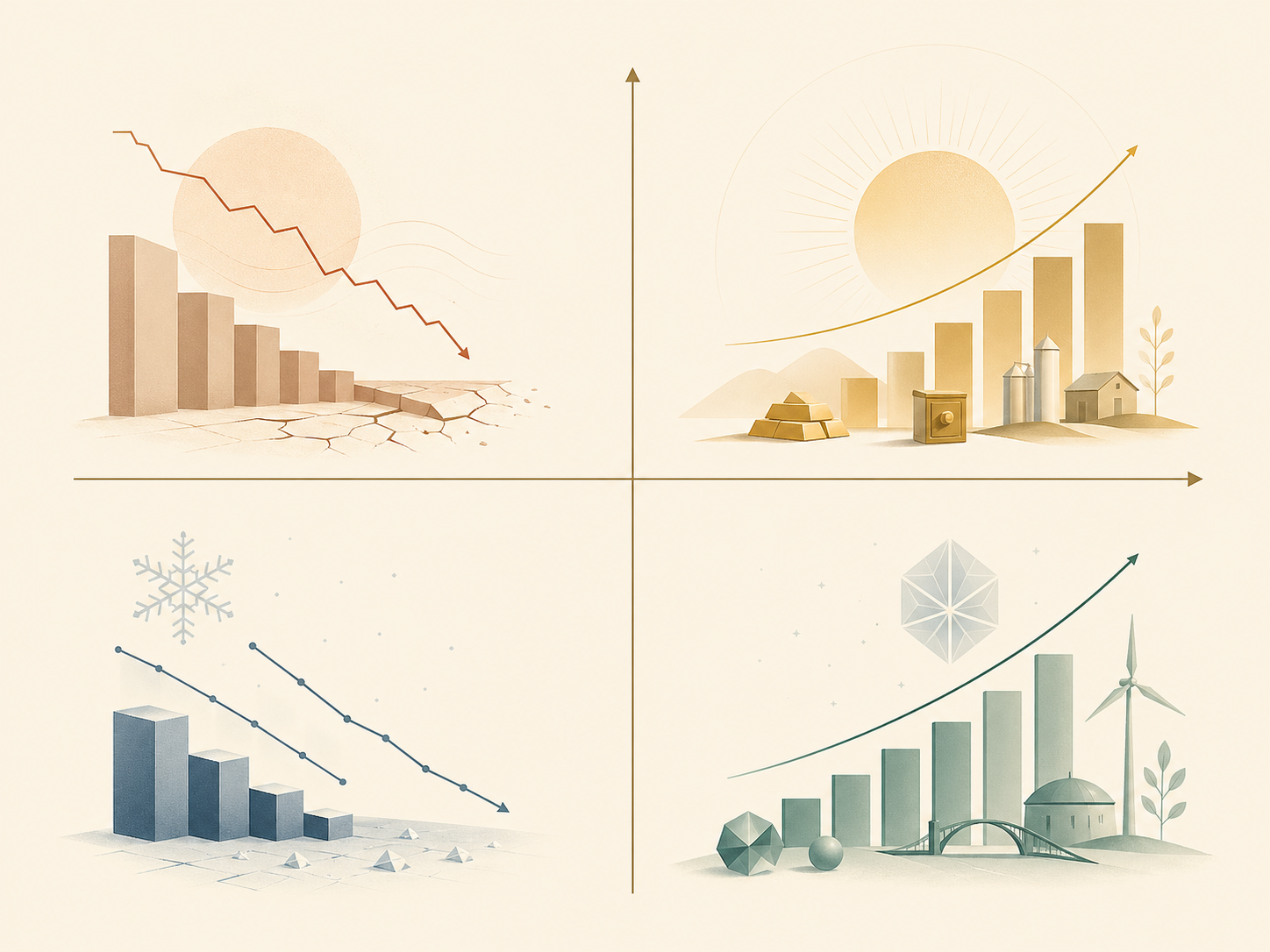
Sometimes growth dominates. Sometimes activity slows. Sometimes money keeps its value. Sometimes it weakens. The 4 environments help organize those situations before judging a portfolio.

Simple idea

Two questions, four climates

A beginner does not need to forecast GDP or official inflation perfectly. The first step is to ask two simple questions: does money still protect purchasing power, and can the economy still turn energy into value? Those two questions create four climates. Portfolios then become easier to read: each asset has a job, but that job depends on the climate.

Inflation Deflation Contraction Growth
Inflation / contraction

Inflation + contraction

This is the hardest climate. Prices rise while activity slows. Companies suffer, bonds may protect poorly, and the portfolio has to look for robustness: solid cash and gold.

Inflation / growth

Inflation + growth

Growth is still present, but prices rise too. Real assets can breathe more easily: cyclical stocks, commodities, energy and gold. Long-duration promises often suffer more.

Deflation / contraction

Deflation + contraction

Activity slows and prices stop rising. The world becomes more deflationary: weak demand, fear and scarcer credit. In that climate, long bonds can regain a solid defensive role.

Deflation / growth

Deflation + growth

This is the climate where the same product becomes cheaper to buy because production improves: better, faster, with less. Efficient companies can prosper, especially genuinely innovative ones.

Reading the environment

Now, how do you know which environment you are in?

Two axes are used: inflation or deflation, then growth or contraction. The two charts below are only reading aids, they do not claim to predict the future.

Beginner reading guide

  1. If gold dominates bonds, the climate is more inflationary or monetary-stress driven.
  2. If bonds dominate gold, the climate is colder or more deflationary.
  3. If stocks dominate oil, the economy seems able to turn energy into profits: it is closer to growth.
  4. If oil dominates stocks, energy becomes a constraint and the climate becomes more dangerous: it is closer to contraction.

Signal 1

Inflation or deflation: look at gold / bonds

When gold dominates bonds, the portfolio should respect inflation risk. When bonds regain the lead, large deflationary phases can appear.

Ratio gold / bonds 7-year moving average

Simple reading: thanks to the 7-year moving average, this chart helps avoid listening too much to market noise and asks whether the environment looks closer to inflation or deflation.

Understanding the 7-year moving average Beginner explanation

Imagine a slow trend line. One market month can move sharply and tell a misleading story. The 7-year moving average takes the last 84 months, averages them, then draws a calmer line.

What is it for?

It reduces noise. Instead of focusing only on the latest violent move, it helps read the broader direction.

Why moving?

Each month, the oldest month leaves the calculation and the newest month enters. The line therefore moves slowly with the market.

Why 7 years?

Because this is not meant to produce a fast buy/sell signal. The goal is to avoid changing your mind after every few-week shake.

On the gold / bonds chart, the blue line is not a prediction: it is a filter. If the ratio only moves briefly around that line, it does not say much. If it stays above for a long time, gold dominates bonds: the market may be looking more at inflation risk and weakening money. If it stays below for a long time, bonds regain control: the signal becomes more deflationary, or points to a colder world.
Signal 2

Growth or contraction: look at stocks / oil

The chart stocks / oil is not official GDP. It only shows whether the market is breathing more growth, or whether energy is becoming strong enough again to make contraction more dangerous.

Note: this ratio is moving close to a contraction signal.

The logical next step

1. Stocks

The sleeve that seeks business growth, while accepting strong volatility.

Read
2. Gold

The monetary sleeve, useful when trust in money or debt becomes less clear.

Read
3. Bonds

The defensive sleeve when deflation, slowdown and falling rates regain control.

Read
4. Cash

The patience reserve, useful to hold on and buy cheaper assets during crises.

Read

What to remember

The 4 environments are not there to make clever forecasts. They help explain why no asset is good all the time. The next step is to read the four basic assets separately: stocks, gold, bonds and cash.